
Marketing has a "where do you start?" problem.
Hire a marketer at a SaaS startup and within a week they're getting pulled in every direction. The CEO wants ads. The head of sales wants better collateral. The product team wants a launch. Someone in Slack just suggested programmatic SEO. Without a playbook, the answer becomes "yes" to everything. Three months later you've shipped a lot of work and moved nothing.
We call that random acts of marketing. It's the default state of most SaaS teams under $5M ARR.
The fix is sequencing. Some marketing efforts only work after others are in place. Ads only convert after the landing page is right. SEO only converts after the pages it points to are tuned. Launches only land after the brand and positioning are sharp. Skip the order and you waste the spend.
Here's the three-phase framework we use to build SaaS marketing engines without burning budget on the wrong work first.
Phase 1 — Foundation: get the existential questions right
The foundation phase is the work no one wants to do. It's the most skipped, the least visible, and the most consequential.
What it covers
A foundation phase includes:
- A marketing audit (where you're actually weak vs. where you think you're weak)
- Customer research (job-to-be-done interviews, review mining, support ticket analysis)
- Positioning (who you're for, what you do, what you don't do, what makes you different)
- Brand identity (visual and verbal)
- A homepage that puts all of the above in one place
Why most teams try to skip it
It's existential work. The questions are uncomfortable: Why do customers actually choose us? What do we stand for? What's our point of view? New marketers who join and inherit positioning, branding, and a homepage from a previous team rarely challenge those assumptions. They run with what's there and start optimizing on top of it.
That's the trap. If your positioning is wrong, every channel you build on top of it will underperform — not because the channel doesn't work, but because the message it's carrying doesn't.
The cleanest analogy is the dirty-dish problem. Most teams want to come in and start cooking — running ads, writing content, launching features. But there's a sink full of dirty dishes (vague positioning, weak homepage, untested customer research) making the kitchen unworkable. Clean those first. Then cook.
What good looks like
After Phase 1, you should be able to answer in one sentence each:
- Who you're for
- What you do for them
- Why you're different from the alternatives
- What proof you have that it works
If any of those four take more than a sentence, Phase 1 isn't done.
Phase 2 — Base: build the marketing engine
Once the foundation is set, Phase 2 is about building the marketing assets the rest of your funnel depends on. This is where most of the practical, visible work lives.
Sales pages
Feature pages, industry pages, solutions pages, and use case pages serve a dual purpose: they rank for keyword-specific searches and function as sales collateral for visitors browsing your site to figure out if you're a fit. Ideally each page does both. If you can only justify one purpose, the page probably doesn't need to exist yet.
A common mistake here is diluting the homepage to cover every persona and use case. Don't. Keep the homepage tight and use sales pages to talk to specific audiences in detail.
Conversion pages
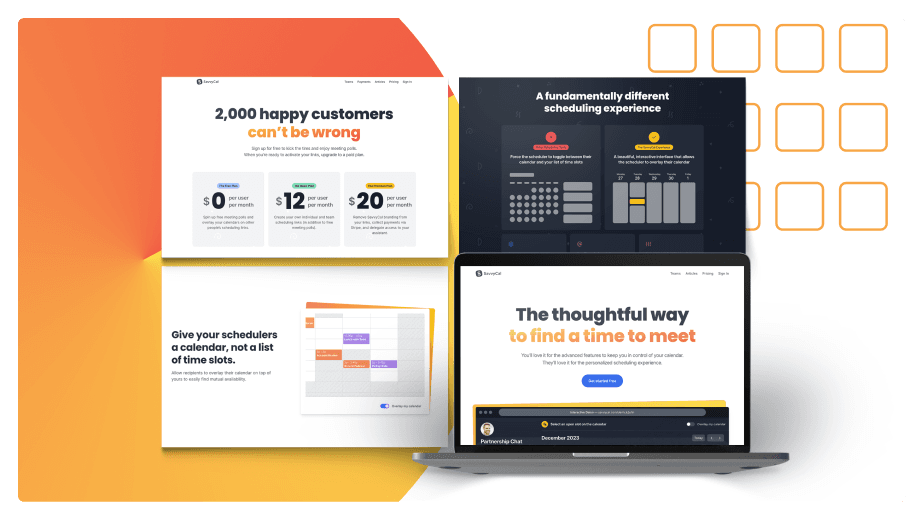
Pricing, signup, and demo pages — the places where intent turns into action. Most companies under-invest here, treating them as afterthoughts. They're not.
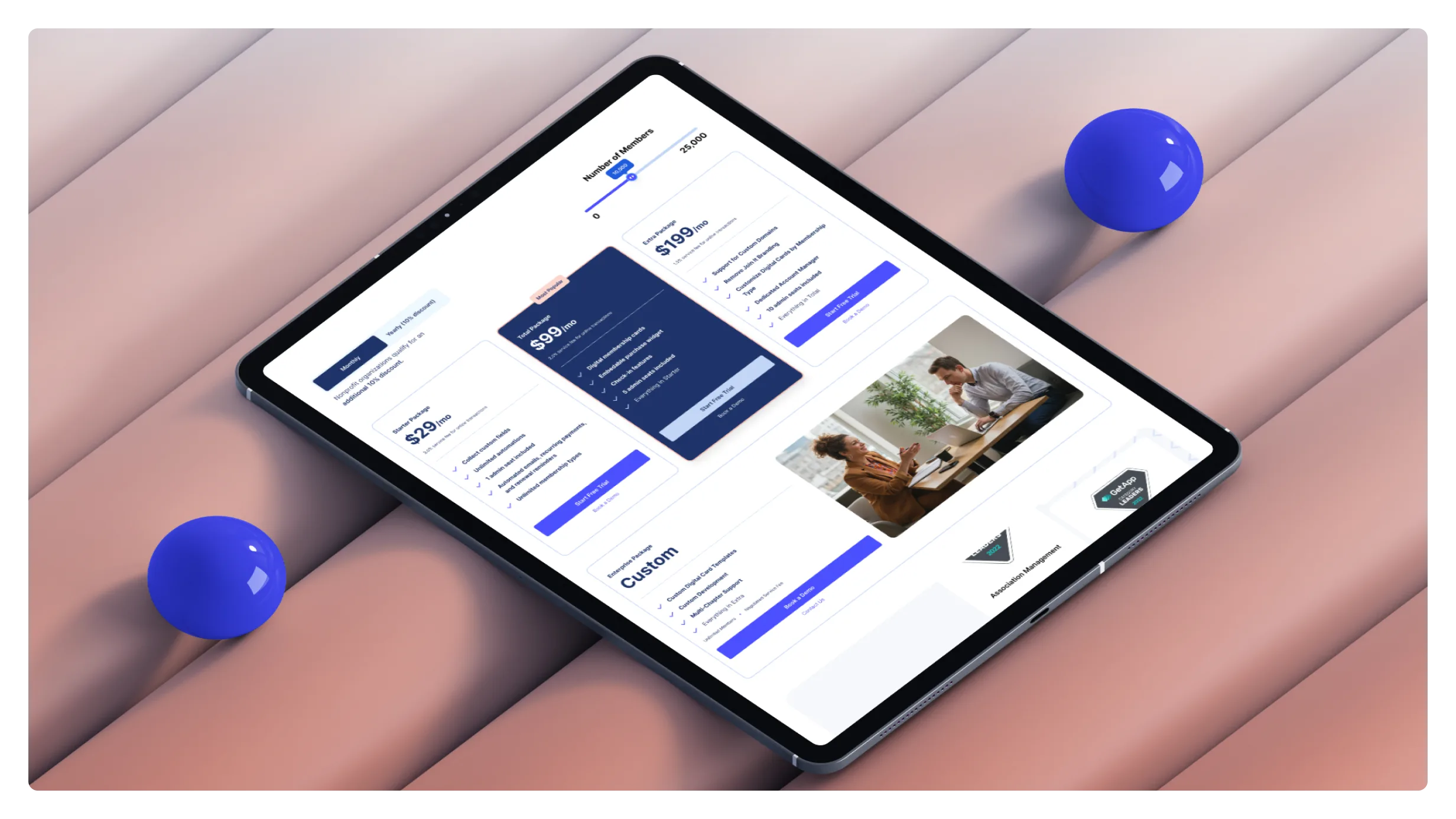
A pricing page isn't the place to communicate every plan in full detail — that's what your billing settings inside the app are for. The pricing page exists to help visitors pick the lowest-friction option and get into the product. Lead with the simplest plan. Compare differences clearly with real visual contrast between tiers, not just identical bolded checkmarks. And for the love of conversion rates, don't list "transaction fee" as a feature with a green check.
Demo pages aren't contact forms. They should reinforce the outcome the visitor is hoping for, handle objections, set expectations for the call, route progressive form fields based on fit, and provide social proof. A well-built demo page does half the qualification work before a sales rep is involved.
Competitor comparison pages
The most underrated SEO and sales asset in B2B SaaS. People are already comparing you to competitors mentally — you may as well control how the comparison plays out.
Two formats work well: head-to-head ("You vs. Competitor") and category roundups ("Competitor Alternatives"). Both rank for high-intent keywords. Both function as sales collateral. The trick is to avoid the obviously-biased green-check-vs-red-X grid that buyers have learned to distrust. Honest comparisons — we do X this way, they do X that way — convert better than disparagement.
Sales collateral
One-pagers, decks, scripts, email templates. These are mostly downstream of the work already done on sales pages — same content, different form factor. They're necessary if you have a sales motion. They're optional if you're fully product-led.
The strongest version of this is when sales collateral and the public-facing site reinforce each other. The more good answers a buyer can find on your site without talking to a rep, the more qualified they are when they finally do.
Onboarding
Onboarding is the second sale. The first sale gets the user signed up. The second sale gets them to pay. With near-zero switching costs in software today, onboarding is often where the actual buying decision happens — long after the marketing team thinks the deal is closed.
Good onboarding is a race to value. Every step should clearly lead the user toward the moment they get the outcome they signed up for. Steps that don't move them toward that outcome get cut.
Email marketing
The companion to onboarding. When users skip steps, get stuck, or wander off the happy path, email is the tool that nudges them back. The majority of email marketing's value in SaaS is reinforcing onboarding — not running monthly newsletters.
Other use cases include retention, billing notices, re-engagement, and lifecycle sales. But the foundation is product-driven email tied to in-app behavior.
Pricing strategy
Pricing is the most sensitive surface in your business. It's also one of the most under-optimized.
The goal isn't to maximize price — it's to anchor pricing to a value metric that scales with the customer's success. As your customer gets more value, you get paid more. The two move together. Get that relationship right and pricing changes feel fair instead of extractive.
For more rigorous pricing work, frameworks like Van Westendorp surveys and MaxDiff analysis can help calibrate what buyers will tolerate. But these tools matter only after your simple, intuitive pricing has actually broken. Before that, simple wins.
Phase 3 — Expansion: pour gas on the fire
Phase 3 is what most teams want to start with. It's also the phase that wastes the most money when started early. Once your foundation and base are solid, expansion is where compounding starts — but not before.
Conversion rate optimization
Two flavors: macro and micro.
Macro CRO is large changes — new positioning on the landing page, swapping demo-led for product-led, restructuring an entire onboarding flow. These are the moves you make when traffic is low and you need to learn fast.
Micro CRO is the headline tests, button experiments, and section reorderings. These only make sense at scale — typically once you're getting at least a few thousand visitors per month per page being tested. Doing micro CRO too early just produces noise.
The right rule: chase the bottleneck. If your sign-up to paid conversion is fine but your traffic to sign-up is broken, fix that. Don't optimize what's already working.
Launches and campaigns
The trap with launches is treating them as a one-time event tied to a product going live. Real SaaS launches are continuous. You should be launching new features, integrations, content campaigns, and points of view on an ongoing basis.
The other trap is shipping in silence. Product teams push features to production constantly because that's their normal — but customers don't see anything they're not told about. A feature that ships without a launch effectively doesn't exist to your audience. Even small quality-of-life improvements get more goodwill than you'd expect when you actually announce them.
Paid ads
Ads come late in the framework on purpose. There's roughly a 99% chance that running ads before your landing pages and funnel are tuned will burn budget. The cost of paid acquisition has gotten high enough that the gap between "this funnel converts" and "this funnel almost converts" is the difference between profitable ads and an expensive lesson.
When ads do run, the mistake most teams make is optimizing the ad creative before optimizing the landing page. The landing page is what's actually within your control and scales. The ad platform's algorithm is mostly out of your hands. Fix the page first.
SEO content
SEO content lives in the expansion phase because content compounds — but only after your sales pages and conversion pages are doing their job. Good SEO content educates the visitor and quietly demonstrates how your product solves the problem they came to learn about. The goal is to rank for the questions your ideal customers are searching, then route those visitors into your existing funnel.
The format that consistently works: question-led, problem-solving content that shows how to do something your product does — sometimes with your product, sometimes without. The "without" version builds trust. The "with" version converts.
Pair SEO content with on-page CRO and the results compound. We've watched a 152-day enterprise sales cycle drop to 23 days by adding well-placed CTAs, quizzes, and demo prompts inside high-traffic blog posts.
Internationalization
When you're ready to expand beyond your home market, internationalization is more than translation. It's domain structure (subfolders over subdomains for SEO), localized payment methods and currencies, in-product language support, localized help docs, and visuals that reflect the audience.
Most US-based SaaS startups can punt this until later — most international buyers will tolerate English-first sites. But once you're intentionally targeting non-English markets, half-measures hurt more than they help.
Web development
The ongoing infrastructure layer. Most of what matters here is two things: don't let your CMS slow your marketing team down, and don't let page performance tank your conversion rate or SEO.
The right CMS makes it easy for a non-developer marketer to ship landing pages, blog posts, and CMS-driven feature pages without engineering help. The wrong CMS turns every page into a dev ticket. Most B2B SaaS teams under $20M ARR are better off on a marketer-friendly platform like Webflow than on a custom-built or WordPress-bound stack.
How to know which phase you're in
The framework isn't always strictly linear. Some teams have strong positioning and just need Phase 2 work. Others have built a lot of Phase 2 and Phase 3 assets on a broken foundation and need to go back.
A quick self-audit:
- Can you explain in one sentence who your product is for, what it does, and why it's different? If no, you're in Phase 1.
- Do you have feature pages, comparison pages, and a tuned pricing page? Is your onboarding actually delivering value to new users? If no, you're in Phase 2.
- Are your conversion rates in a healthy range and your funnel mostly intact, and you mainly need to scale acquisition? You're in Phase 3.
If you've worked with a strong agency or in-house team in the past on Phase 1 elements, you can sometimes skip ahead. But the foundation work is so often incomplete that an audit usually surfaces two or three real gaps. It's faster to confirm Phase 1 is done than to discover six months later that it wasn't.
Frequently asked questions
What are the three phases of SaaS marketing?
Foundation, base, and expansion. Foundation covers the existential work — customer research, positioning, branding, audit, and homepage. Base covers the marketing engine — sales pages, conversion pages, competitor comparisons, sales collateral, onboarding, email, and pricing. Expansion covers scale — CRO, launches, ads, SEO content, internationalization, and web development. The order matters because each phase depends on the one before it.
Can I skip Phase 1 if I already have a website?
Usually not. Most existing positioning, branding, and homepages were built quickly during product development and never re-validated against real customer research. You can confirm Phase 1 is done in a short audit — but that audit is rarely "all good, move on." It's usually "two or three big gaps to fix before we build on top of this."
Why are paid ads in Phase 3 instead of earlier?
Because ads amplify whatever your funnel currently does. If your landing page converts at 2%, ads will convert at 2%. If your landing page is broken, ads will burn money quickly. The cost of paid acquisition today is too high to use ads as a learning tool. Get conversion working organically first, then pour gas on it.
What's the difference between sales pages and conversion pages?
Sales pages (feature, industry, solutions) are content-heavy pages designed to educate and persuade — they often rank for search queries and act as digital sales collateral. Conversion pages (pricing, signup, demo) are action-oriented — their job is to turn intent into a transaction. Both matter, but they serve different points in the funnel.
How long does the full framework take?
Phase 1 typically takes 4–8 weeks of real work, depending on how much customer research is needed and how much positioning work hasn't been done. Phase 2 is ongoing for 3–6 months as marketing assets get built out. Phase 3 is continuous — there's no end to CRO, launches, content, and channel work. The framework isn't a project with a finish line; it's a sequence for prioritizing what to work on next.
Is this framework only for B2B SaaS?
It maps best to B2B SaaS because that's where we've built it, but the core sequencing — foundation before base before expansion — applies to most digital businesses. The specific assets in each phase change by category. The principle of fixing your foundation before pouring spend on top of it doesn't.